
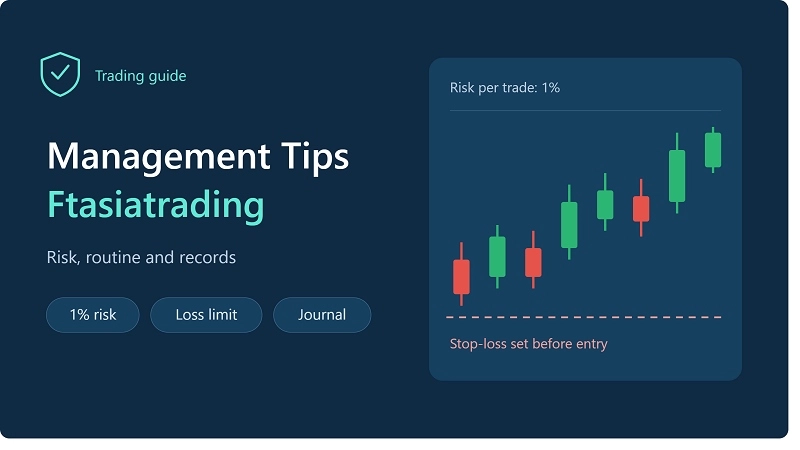
Ask around in any trading group and you’ll hear the same story. Somebody had a great week, felt sharp, bumped up the size, and lost most of it in one afternoon. The analysis wasn’t the problem. The next decision was. That’s the gap Management Tips Ftasiatrading try to fill. Forget entries for a moment. This is about what you do with money, time, and your own head once the trade is open, and what you do after it closes. Nothing here promises a return. Trading can lose money, and sometimes it will. Good management just keeps the losses small enough to survive.
Why Sizing Beats Signals
Most people hunt for a better entry. Fair enough, entries are fun. But try this: take any decent strategy and run it with 1% risk per trade, then again at 10%. Same signals, same results on paper. One account survives a bad stretch. The other doesn’t see the end of the month.
“Position size rarely gets attention, but it sets the ceiling on every loss you take. Two traders can use the same entry rule and end up in very different places, simply because one risks 1% a trade and the other risks 8%. Strong signals still fail now and then. Controlled size means those failures stay small enough to recover from.
Management Tips Ftasiatrading Begin With Your Own Money
First, use cash you can lose. If a bad month would make rent hard, you’re already trading scared, and scared traders cut winners early and sit on losers. Second, pick a risk figure. Many experienced traders sit around 1% to 2% of the account per trade. Choose yours, write it on a sticky note, and stop negotiating with it.
Here’s the maths on a $5,000 account at 1%:
Risk per trade: $50
Stop 50 cents below entry
$50 ÷ $0.50 = 100 shares
Ten straight losses at that size cost about 10%. Ugly, yes. Survivable, also yes.
Third, set a monthly floor. Say 6%. Hit it and you stop until next month, then go through every trade on paper. Without a floor, bad months feed themselves, because you keep trading harder to fix them.
One Page, Not Ten
Plans stored in your head drift. One sharp move and the rules quietly change without telling you. So write a single page. It should cover what you trade, which hours, the conditions you need before entering, where your stop sits, where you take profit, and how many positions you’ll hold at once. That’s it. If it takes more than a minute to read, trim it. I know people who wrote elaborate rulebooks and never opened them again. A short page gets checked mid-session, and a checked plan gets followed more often than a forgotten one. If a setup doesn’t match the page, skip it. Skipping counts as a decision, and some days it’s the best one you make.
Hours Matter Too
Staring at charts for eight hours doesn’t make you sharper. By hour four you’re seeing patterns that aren’t there. Pick one or two sessions that suit your strategy, then close the platform. Track results by hour for a month. Plenty of traders find their whole edge hides in one short window, and everything outside it just leaks money. A simple routine helps. Before the session, check the news calendar and mark your levels. During it, trade only what the plan allows. After it, spend ten minutes writing up the day, including setups you skipped. It’s the unglamorous part of Management Tips Ftasiatrading, and honestly the part that works the most.
What to Do After a Loss
Revenge trading is the oldest trap there is. You lose, it stings, and a minute later you’re in another trade to win it back. That trade wasn’t planned. It was anger with a ticker symbol.
Rules beat willpower here, because willpower runs out around the third loss. Some that work:
Two losses in a row, you’re done for the day
Fifteen minutes away from the screen before the next order
No adding to a trade that’s already losing
Hot streaks need rules too. Five wins in a row feels wonderful, and that’s exactly when size starts creeping up. Risk the same amount after five wins as after five losses.
The Journal Nobody Wants to Keep
Memory flatters you. You recall the clean winners and forget the sloppy ones. A journal doesn’t flatter anybody. For each trade, write the date, instrument, entry, stop, exit, size, and money at risk. Add one line about why you took it. Then one word for your mood: calm, bored, rushed, nervous. Sounds silly. After a month you’ll notice most losses share the same word.
Read it every Sunday. Maybe Friday afternoons cost you. Maybe your best trades come from one setup and your worst from another you never quite believed in. Monthly, work out your win rate, average win, and average loss. A 40% win rate can make money when winners are twice the size of losers. A 70% win rate can lose money if one big loss erases twelve small wins. Win rate alone tells you very little.
Running a Small Desk or Group
Maybe you look after a few newer traders. The same ideas apply, with a few tweaks. Give each person their own limit and strategy. Meet briefly every week instead of holding one long meeting every quarter. Praise the trader who followed the plan and lost. Ask questions of the one who broke the rules and won, because rewarding luck breeds recklessness. And make admitting mistakes cheap. People hide errors when they fear blame, and hidden errors grow. Management Tips Ftasiatrading only work on a team when someone can say “I broke the rule” without paying for it.
Mistakes Worth Dodging
Moving a stop further away. This turns a small, planned loss into a big, unplanned one. Heavy leverage. It magnifies mistakes as fast as gains. Chasing. Missing a trade costs nothing. Rushing one often does. Switching strategies after a short losing run. Every method has ugly stretches, and ten trades prove very little. Skipping the review. No feedback, same mistakes, more confidence.
A Four-Week Start
Don’t rebuild everything on Monday. You won’t keep it up.
Week one: set your per-trade risk and monthly floor. Write both down.
Week two: draft the one-page plan and start the journal.
Week three: add the routine and the after-loss rules.
Four Week: review everything and change one thing. Only one.
New to this? Run it all on a demo account first, and follow every rule as if the money were real. A demo teaches nothing if you play it like a game.
Where This Leaves You
Price direction is outside your control. Your size, hours, reactions, and records are not. Treat Management Tips Ftasiatrading as something you return to each week, not a one-time read. Look through your last twenty trades, find where you lose the most, and fix that first. A small daily change beats a big overhaul you abandon in a week. Risk never disappears. Measure progress by how well you handle it, this month against last.
For more important information please visit my website: myfastbroker