

Understanding market trend ftasiastock starts with one important idea: financial markets move in response to economic conditions, company performance, investor expectations, and global events. FTAsiaStock focuses on financial and business information that can help readers understand these movements, especially in Asian markets. For beginners, market trends explain why stock prices rise, fall, or remain relatively stable. Learning to recognize these patterns can improve investment research, highlight potential opportunities, and help investors understand the risks associated with changing market conditions.
In this guide, we’ll explain what FTAsiaStock covers, examine important Asian market developments in 2026, and show you how to analyze market trends without relying on predictions or speculation.
What Is Market Trend FTAsiaStock?
The term market trend FTAsiaStock generally refers to information about financial market movements, stock performance, economic developments, and investment trends associated with FTAsiaStock content.
According to its About Us page, FTAsiaStock aims to provide research-oriented coverage of financial markets, business trends, banking, economic indicators, and investment-related subjects. Its editorial focus includes Asia and international developments.
Understanding FTAsiaStock and Its Market Coverage
The platform describes several primary areas of coverage:
-
Stock market movements: Developments affecting stock prices and market indexes.
-
Business trends: Corporate activities, emerging industries, and sector developments.
-
Economic analysis: Inflation, monetary policy, and changes in economic conditions.
-
Investment education: Information that helps readers understand financial markets.
Readers can use this type of coverage to identify subjects worth investigating. However, market commentary should always be checked against current exchange data, official company announcements, and trustworthy financial sources.
Why Market Trends Matter to Investors
Imagine that technology companies begin reporting stronger earnings while demand for their products increases.
Investors may become more optimistic about the sector, potentially raising share prices. However, rising prices can also reflect expectations that are already too optimistic.
Understanding the underlying trend helps investors distinguish between improving business performance and short-lived market excitement.
How Do Financial Market Trends Work?
A market trend describes the general direction of an asset’s price over a specific period.
Prices rarely move in a perfectly straight line. Even during strong upward trends, markets experience temporary declines and periods of uncertainty.
Bullish, Bearish, and Sideways Trends
The three common market conditions are easy to recognize once you understand their basic characteristics.
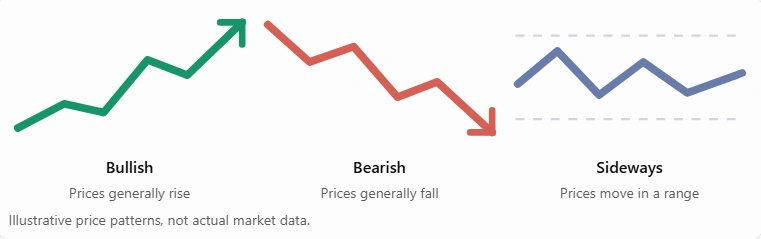
| Market trend | Characteristics | Main consideration |
|---|---|---|
| Bullish | Higher prices over time | Avoid overpaying |
| Bearish | Sustained downward pressure | Manage potential losses |
| Sideways | Prices fluctuate within a range | Watch for false breakouts |
Short-Term vs. Long-Term Market Trends
Short-term trends may last several days or weeks and often respond to earnings announcements, political developments, and changing investor sentiment.
Long-term trends develop over months or years. They can reflect wider economic changes, technological progress, and sustained business growth.
For beginners, distinguishing these timeframes is particularly important. A temporary market decline does not automatically mean a long-term growth trend has ended.
Major Asian Market Trends to Watch in 2026
The Asian financial landscape includes advanced economies, rapidly developing markets, and major global manufacturing centers.
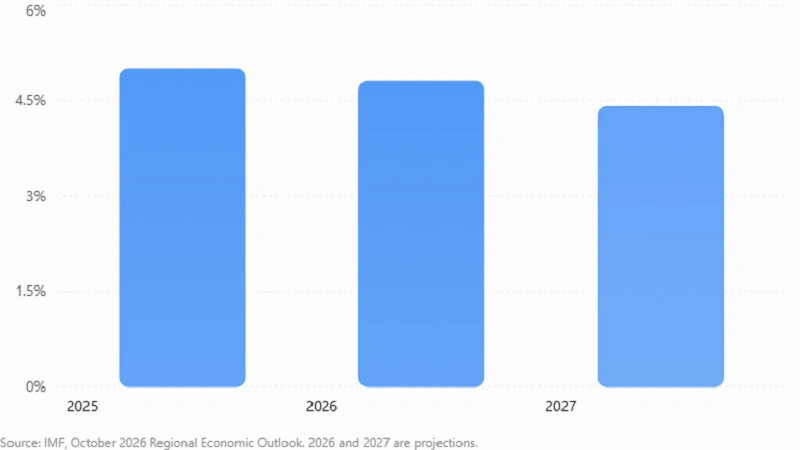
The International Monetary Fund projected Asia-Pacific economic growth of 4.8% in 2026 and 4.4% in 2027 in its October 2026 regional outlook. These are economic growth forecasts, not predictions of stock market returns.
IMF Asia-Pacific real GDP growth
1. Artificial Intelligence and Technology Investment
Artificial intelligence remains an important influence on Asian technology industries. Companies involved in semiconductors, memory chips, cloud infrastructure, and data centers have benefited from rising demand for AI-related equipment. The IMF’s October 2026 assessment identifies strong technology demand as a major contributor to regional economic resilience, particularly in technology-exposed economies such as South Korea.
However, strong industry growth does not guarantee profitable investments. A company can expand revenue while its stock performs poorly if the initial share price already reflects unrealistic expectations.
What beginners should monitor: Revenue growth, earnings, capital expenditure, semiconductor demand, and company valuations.
2. Inflation and Interest Rate Changes
Inflation and interest rates influence business costs, household spending, and the value investors assign to future earnings. Higher interest rates can make borrowing more expensive and may reduce the attractiveness of some higher-risk investments. Lower interest rates can support economic activity, although their effects depend on why rates are falling and the condition of the broader economy. When analyzing Asian financial markets, compare central bank policy decisions with inflation figures rather than assuming every interest rate cut will boost share prices.
3. Global Trade and Supply Chain Adjustments
Asia plays a major role in global electronics, industrial equipment, and consumer goods production.
Changes in tariffs, export restrictions, shipping costs, and international demand can affect company revenues and operating margins. The IMF’s October 2026 outlook highlights trade reconfiguration alongside energy pressures and the AI boom as three major forces influencing the region. This makes trade-related developments especially important for companies dependent on overseas customers or imported materials.
4. Energy Costs and Emerging Economies
Energy prices affect transportation, manufacturing, electricity generation, and household purchasing power. Countries heavily dependent on imported fuel can face additional pressure when international energy prices rise. Meanwhile, emerging Asian economies may offer long-term opportunities through infrastructure development, manufacturing, financial services, and digital adoption. Yet investors should examine each country independently. Exchange-rate movements, policy decisions, and financial stability can produce very different outcomes across markets.
Key Indicators for FTAsiaStock Market Analysis
Successful market analysis requires more than watching stock prices. Investors should combine price movements with business performance, economic conditions, and market sentiment.
The following indicators can help beginners develop a more informed view of stock market trends.
| Indicator | What it measures | Why it matters |
|---|---|---|
| Stock market index | Performance of a group of stocks | Shows broad market direction |
| Trading volume | Number of shares traded | Helps assess market activity |
| Moving average | Average price over a period | Helps identify price direction |
| Relative Strength Index (RSI) | Speed and magnitude of price changes | Highlights momentum conditions |
| Price-to-earnings ratio | Share price relative to earnings | Helps evaluate valuation |
| Inflation rate | Changes in consumer prices | Influences costs and monetary policy |
| GDP growth | Changes in economic output | Provides broader economic context |
Stock Market Indexes and Trading Volume
Market indexes summarize the performance of selected companies. They help investors understand whether a market is broadly advancing or declining.
Some major Asian market benchmarks include:
-
Nikkei 225: A widely followed benchmark for Japanese equities.
-
Hang Seng Index: Tracks major Hong Kong-listed companies.
-
Shanghai Composite: Represents stocks listed on the Shanghai Stock Exchange.
-
Nifty 50: Measures the performance of 50 major Indian companies.
-
KOSPI: A benchmark for South Korea’s stock market.
Trading volume adds another layer of information. For example, a price increase accompanied by unusually high trading activity may suggest strong market interest, although it does not guarantee that the upward movement will continue.
Moving Averages, RSI, and Valuations
A moving average smooths out daily price fluctuations, helping investors identify the direction of a price trend. The 50-day and 200-day moving averages are commonly used to evaluate intermediate and longer-term market behavior. The Relative Strength Index, or RSI, measures price momentum on a scale from 0 to 100. Traditionally, values above 70 suggest potentially overbought conditions, while readings below 30 suggest potentially oversold conditions. These readings are not automatic buying or selling signals. Strong trends can keep RSI elevated or depressed for extended periods.
Valuation indicators, such as the price-to-earnings ratio, are useful alongside technical indicators because they help investors consider what they are paying for a company’s profits.
How to Analyze Market Trend FTAsiaStock Step by Step
You do not need an advanced financial background to begin analyzing markets. A consistent process is more useful than trying to predict every price movement.
Step 1: Choose a Market or Industry
Start with one market, such as Japan or India, or choose an industry such as technology or banking.
Avoid monitoring dozens of unrelated investments when you are learning. Focusing on a smaller selection makes it easier to understand which developments influence prices.
Step 2: Examine Recent Price Movements
Compare an index or stock over the past month, six months, and a year.
Look for patterns such as higher highs, lower lows, or prices moving within a narrow range.
These observations can help identify the prevailing trend, but they should not be treated as reliable forecasts.
Step 3: Review Economic Developments
Read current reporting about inflation, interest rates, trade policies, and business activity.
FTAsiaStock can serve as a starting point for identifying financial topics. Confirm important facts using central bank publications, official exchange releases, and company investor-relations websites.
Step 4: Evaluate Company Fundamentals
If you are researching individual stocks, examine revenue, profit margins, debt, cash flow, and management commentary.
Consider whether the company’s financial performance supports its current valuation.
A business experiencing strong sales growth may still represent a risky investment if its price is excessive or its debt obligations are difficult to manage.
Step 5: Compare Multiple Indicators
Do not rely exclusively on a chart pattern or a financial news headline.
Compare market direction with earnings, valuations, economic indicators, and trading activity.
A useful exercise is to write down both the strongest argument supporting an investment and the strongest argument against it.
Step 6: Monitor Results and Update Your Analysis
Financial conditions change, so review your original assumptions whenever significant new information becomes available.
For long-term investors, frequent monitoring does not necessarily require frequent trading.
Practical Example: Understanding a Technology Stock Trend
Imagine a fictional Asian semiconductor company called ExampleChip Ltd.
Its share price rises from $100 to $120 over three months.
The percentage increase is:
At first glance, a 20% increase appears encouraging.
However, consider two possible explanations.
Scenario A: Revenue increases, profit margins improve, and demand for the company’s products remains strong. The price increase may reflect improving financial performance.
Scenario B: The company reports disappointing earnings, but its shares rise because investors expect future AI-related growth. The price increase may depend heavily on speculation.
Both scenarios show an upward price trend, but their underlying financial conditions are different.
This example demonstrates why market trend FTAsiaStock research should combine market news, financial performance, and valuation analysis.
How Market Trends Affect Investment Decisions
Market trends can influence investment choices, but their importance depends on an investor’s objectives and risk tolerance. A long-term investor saving for retirement may focus more on diversified investments and sustainable earnings growth. A short-term trader may pay closer attention to price momentum, liquidity, and technical indicators. However, frequent trading introduces additional transaction costs and the possibility of significant losses.
Managing Risk During Market Volatility
Market volatility refers to the extent and frequency of price changes.
The U.S. Securities and Exchange Commission explains that diversification and asset allocation can help investors manage risk, although neither eliminates the possibility of losses.
Beginners can consider several risk-management practices:
-
Spread investments across appropriate assets and sectors.
-
Avoid committing money needed for near-term expenses.
-
Establish financial goals and a suitable investment horizon.
-
Evaluate investments based on research rather than social media excitement.
-
Review portfolio allocations periodically.
The SEC also emphasizes that attempting to time market movements can hurt long-term results when investors buy after prices have risen and sell during declines.
Common Mistakes Beginners Should Avoid
Understanding the market is valuable, but avoiding unnecessary mistakes is equally important.
Following Headlines Without Verification
A dramatic financial headline may describe a genuine event without explaining its broader context.
Read beyond the headline and verify whether the information comes from an official source, company filing, or credible financial publication.
Assuming Every Rising Stock Is a Good Investment
An upward price trend does not automatically indicate strong fundamentals or an attractive valuation.
Ask whether expected earnings growth realistically supports the stock’s price.
Ignoring Currency and Country Risks
International investing introduces risks beyond changes in share prices.
A foreign investment may increase in local currency terms but deliver weaker returns when converted into the investor’s home currency.
Political decisions, market regulations, and liquidity conditions can also influence investment outcomes.
Confusing Market Analysis With Guaranteed Predictions
Financial analysis estimates potential outcomes using available information. It cannot eliminate uncertainty.
No market research website, indicator, or forecasting model can consistently guarantee future investment returns.
People’s also Frequently Asked Questions:
1. What does market trend FTAsiaStock mean?
Market trend FTAsiaStock refers to searches for information about financial market movements, stock market developments, and investment trends associated with FTAsiaStock’s financial content.
2. Is FTAsiaStock suitable for beginners?
Its finance and business-related articles may be useful as introductory reading. Beginners should still confirm important claims through recognized financial institutions, stock exchanges, and official company documents.
3. Can FTAsiaStock predict stock market movements?
No financial news or analysis source can guarantee accurate predictions. Market analysis can help readers understand possible scenarios, but future prices remain uncertain.
4. Which factors influence Asian stock market trends?
Major influences include inflation, interest rates, corporate earnings, international trade, exchange rates, commodity prices, and changes in investor expectations.
5. What is the best way to identify a market trend?
Start by examining price behavior over multiple timeframes. Then compare moving averages, trading activity, business fundamentals, and broader economic conditions. No single indicator is sufficient.
6. Are Asian stock markets good for long-term investment?
Asian markets offer exposure to different economies and industries, but investment suitability depends on valuation, diversification, financial goals, and personal risk tolerance. Regional growth does not guarantee positive stock returns.
Final Thoughts
Understanding market trend FTAsiaStock is about developing the ability to interpret financial information rather than chasing every market movement. Asian financial markets are influenced by powerful economic forces, including technological development, international trade, energy costs, and monetary policy. These developments create opportunities, but they also introduce uncertainty. FTAsiaStock’s financial coverage can help beginners discover relevant market topics. For investment decisions, its content should be combined with verified financial data, company fundamentals, and independent research.
The most useful habit is simple: Understand the trend, investigate what drives it, evaluate the risks, and make decisions based on evidence rather than excitement.
For more information, please visit my website: myfastbroker